Diamonds Guide
At Engagement-Rings.co.uk, we specialise in creating beautiful engagement rings set with ethically sourced lab grown diamonds of an excellent Cut or Make, that shine with unmatched brilliance.
We also produce rings set with natural diamonds for which we remain competitively priced whilst also ensuring that the natural origin is guaranteed. All natural stones are additionally screened prior to being set – even the small ones down to 0.9mm.
What is a Lab Grown diamond?
A laboratory grown diamond is a real diamond (not a simulant like Cubic Zirconia), and is in essence a crystalline form of the chemical element Carbon, which has been created via a manufacturing process by a technician in a lab. The two main processes for this are chemical vapor deposition (CVD) and high pressure high temperature (HPHT).
Natural diamonds are composed of pure carbon too, and are generally created by high pressure and heat deep in the Earth, which then get transferred to the surface through geological phenomena such as volcanic eruptions.
Lab grown diamonds have an identical optical appearance to natural diamonds, and share the same chemical and physical properties.
How are lab-grown diamonds created?
To manufacture a diamond in a lab a small flake/piece of diamond (otherwise known as a seed diamond) is first required, then either of the two techniques mentioned below can be used.
- High-Pressure High-Temperature (HPHT)
The diamond seed is placed into a small square cell along with pure carbon and a metal catalyst, the cell is then placed within a press in which anvils squeeze and apply pressure from all sides. Ultimately the cell is subjected to high pressure (in the region of 1 million pounds per square inch), along with very high temperatures of around 1,450 Celsius.
The HPHT process results in the melting of the catalyst, which dissolves and mixes with the carbon. This now liquid carbon is forced towards the diamond seed crystal, with which it eventually
combines begins to crystallize on. This process continues and the seed effectively stimulates the growth of a new diamond.
- Chemical Vapour Deposition (CVD)
For this technique a diamond seed is placed into a vacuum chamber, which is then depressurised and filled with hydrocarbon and hydrogen gases, before being heated to around 800 degrees Celsius.
Once heated up the electrons from the gases separate from their nuclei, and proceed to form a plasma cloud.
A precipitation process is induced and carbon atoms effectively rain down onto the seed, which slowly atom by atom grows into a larger diamond crystal.
Finally as with a natural diamond, the lab stone is finished off by going through a cutting and polishing process, otherwise known as lapidary.
Setting
All of our diamonds are set using the latest technology to ensure that the stones not only look at their best, but are also secure long term. Our setters use high power microscopes and pneumatic engraving tools for precise high quality work.
The 4 C's
In order to work out a diamonds value and quality there is a standard way of appraising it, by using criteria called the 4 C's, which relates to the Clarity, Carat, Cut and Colour of a stone. Diamond appraising is a complex task with only very minor differences between grades, which can only be determined using the relevant tools and under strict lighting conditions.
To try and simplify diamond appraising, the 4 C's are explained in greater detail below.
Diamond Clarity
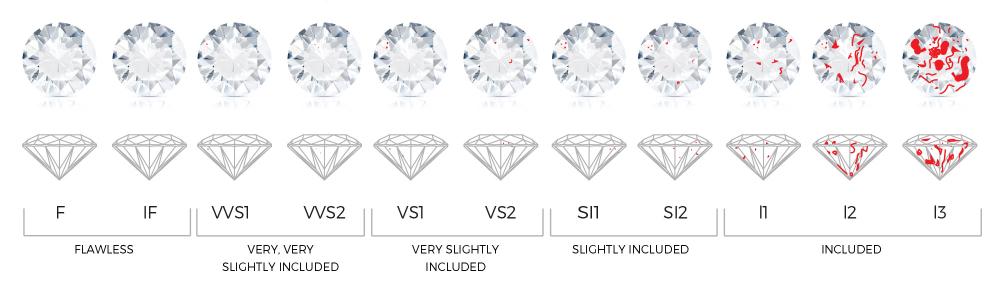
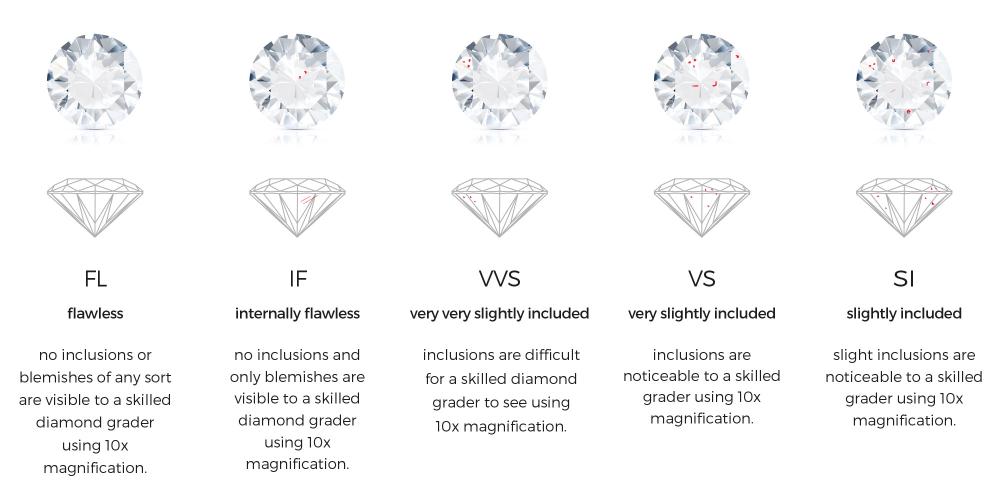
Clarity relates to the number of imperfections a stone has. These imperfections are called inclusions, which are technically anything from minute cracks to small traces of non crystallised carbon. Diamonds will invariably have inclusions to some degree, however its generally accepted that the fewer the inclusions the better.
To grade a diamond's clarity a gemmologist will use a 10x magnification glass (also known as a jeweller's loupe) to zoom in on the stone and analyse the clarity.
Diamond Carat
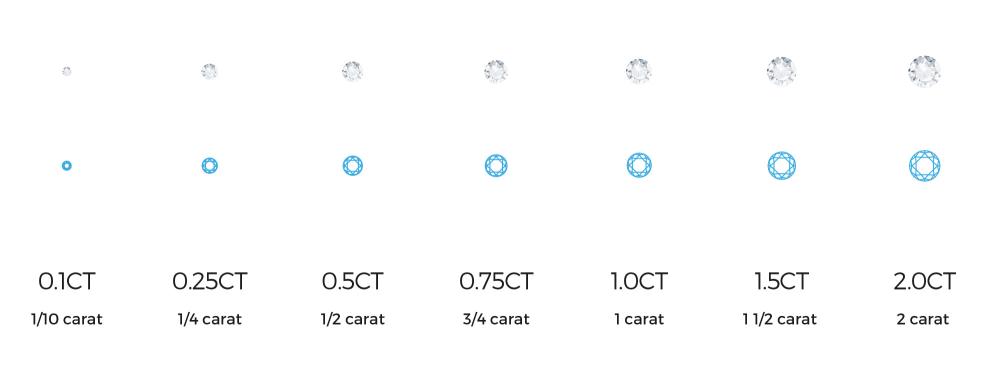
Carat relates to the weight of a diamond, and not specifically the size.
One carat weighs precisely 200mg or milligrams.
Jewellery that comprises more than one stone will have a total diamond weight. Total diamond weights are not as valuable as the equivalent individual diamond weight, i.e. a ring with five diamonds with a total weight of 1 carat is not as valuable as a ring with one diamond weighing 1 carat.
Big diamonds have bigger prices, as the size of a stone increases so does the rarity and value. For example a 2 carat diamond is around four times as valuable as a 1 carat diamond of equal quality.
The chart below will help you understand the approximate size of a diamond for its stated weight.
| Carat | Size (mm) |
| 0.10 | 3.00 |
| 0.15 | 3.40 |
| 0.20 | 3.80 |
| 0.25 | 4.10 |
| 0.30 | 4.40 |
| 0.40 | 4.70 |
| 0.50 | 5.00 |
| 0.75 | 5.80 |
| 1.00 | 6.50 |
| 2.00 | 8.20 |
| Carat | Size (mm) |
| 0.10 | 2.70 |
| 0.15 | 2.90 |
| 0.20 | 3.20 |
| 0.25 | 3.50 |
| 0.30 | 3.80 |
| 0.40 | 4.00 |
| 0.50 | 4.40 |
| 0.75 | 4.90 |
| 1.00 | 5.50 |
| 2.00 | 7.00 |
Diamond Cut
Cut determines two things about a stone.
Firstly it refers to the actual shape of a diamond (e.g. round, square, oval etc). Round shaped diamonds are known as brilliant cut diamonds, and square shaped ones are called princess cut diamonds, octagonal is an emerald cut etc. The chosen shape of a diamond will determine the pattern used for the facets, and how the stone is actually cut and formed by the lapidarist (skilled stone cutter).
Once a stone has been shaped the diamond cut usually then refers to how well it’s been made, so how good the overall proportions, symmetry and polish of the stone are. Cut or make is generally regarded as the most important factor in a diamonds overall finish, determining how well it will sparkle, and how much light is reflected back out of the top of the stone. This is graded from Poor to Excellent.
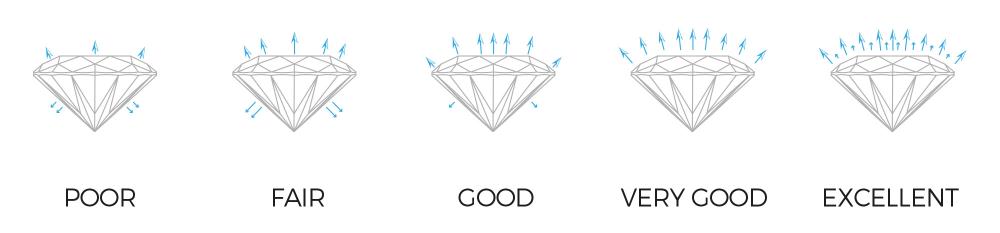
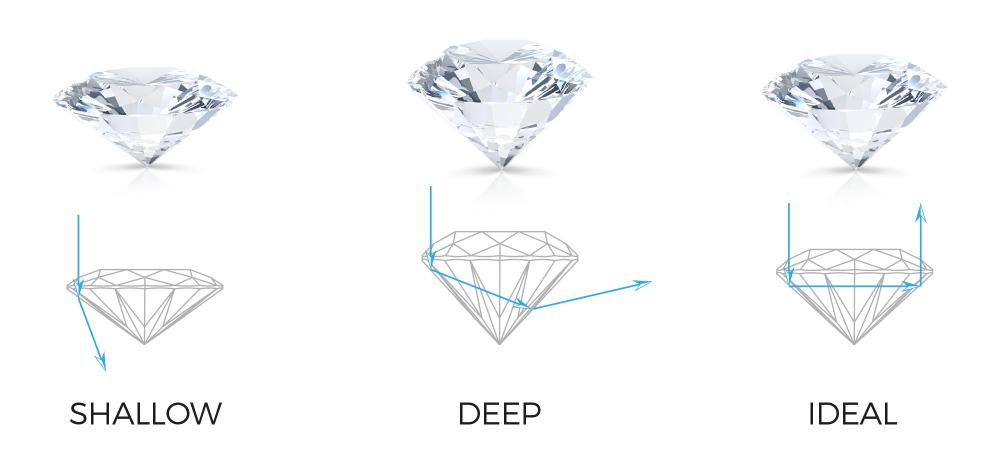
The proportions of a diamond are very important as there’s an ideal set of these for every stone shape. For example a 1 carat brilliant cut diamond could actually have a width of around 6mm (rather than the ideal 6.5mm), and therefore to maintain the same 1ct weight it must be a deeper stone, this not only physically makes the stone smaller to look at once set into a ring, but also impacts on how well the light travels through it, resulting in light being lost though the side or bottom of it, which of course impacts on how well it sparkles.
Diamond Colour
The colour of a diamond is based upon a standardised scale (ranges from D – Z), which is set by The Gemological Institute of America. In order to determine a diamonds colour a set of master stones are used to compare with it side by side – a gemmologist will perform this comparison under strict lighting conditions.
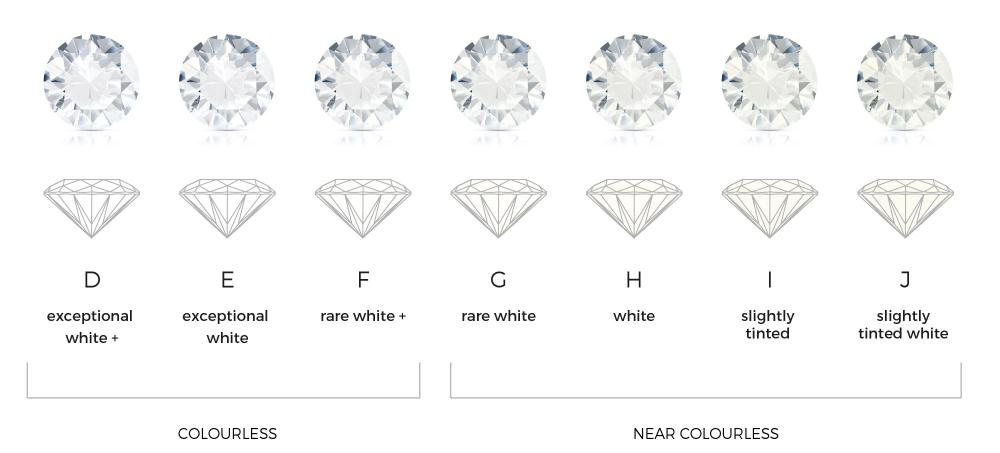
There are only very few diamonds in the world that are truly colourless, and these are the most expensive of stones, assuming they are of excellent cut and clarity. Generally speaking the more colour a diamond has the less valuable it becomes, although there are exceptions for very rare fancy colours, which tend to have very vivid and intense colours that are of great appeal.
It’s also worth noting that the surrounding environment can affect a diamonds colour, this is why it's best to let an expert gemmologist asses a diamond's colour under strict lighting conditions.
Conflict Diamonds
We only select diamonds that are ethically sourced and free from worldwide conflict.
SafeGuard Jewellery Assessment
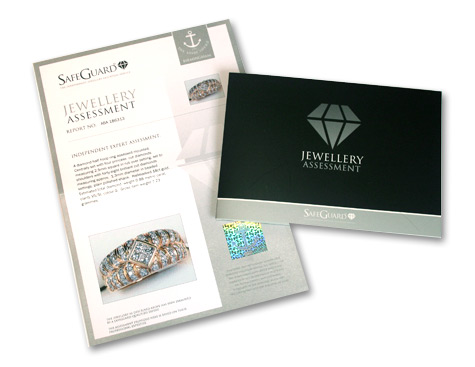
For additional peace of mind when purchasing stone set rings from us, we can also offer a SafeGuard Jewellery Assessment Report. The report is an independent expert assessment carried out by SafeGuard, who are part of the Birmingham Assay Office.
The report is an overall description of the ring, but also includes:
- Diamond Quality
- Diamond Sizes and Gross Weights
- Precious Metal Type
- Digital Photograph of Ring
- Individually Hologrammed Booklet
The standard timescale for a Jewellery Assessment is approximately 2 weeks, although an express service is also available.
We cannot offer a refund on Jewellery Assessments, however we are happy to send your jewellery for appraisal after you have tried it first.
Please note: The SafeGuard Jewellery Assessment is not a valuation service, for Independent Valuations we use SafeGuard Valuations.